Industry Experience & Research

J.P. Morgan · London

PhD Associate (part-time), Quantitative Research · October 2023–Present

Alongside my doctoral research at Oxford, I work closely with the Quantitative Research team at J.P. Morgan, with personal sponsorship from them (about £288k). My work focuses on credit risk and CDS pricing, combining statistical methods with financial modeling.

Estimating CDS Spreads for Illiquid Counterparties

  • CDS spreads are essential for valuing counterparty credit risk and calculating credit valuation adjustments (CVA), yet many counterparties lack liquid CDS quotes.

  • Estimating proxy credit spreads for illiquid counterparties is required under Basel’s standardised approach to CVA risk and remains a practical challenge for major dealer banks.

  • Our research draws on equity-market information to uncover and model the links between equity and credit markets. The resulting methods support daily credit risk valuation and provide a framework for hedging credit risk with equity options.
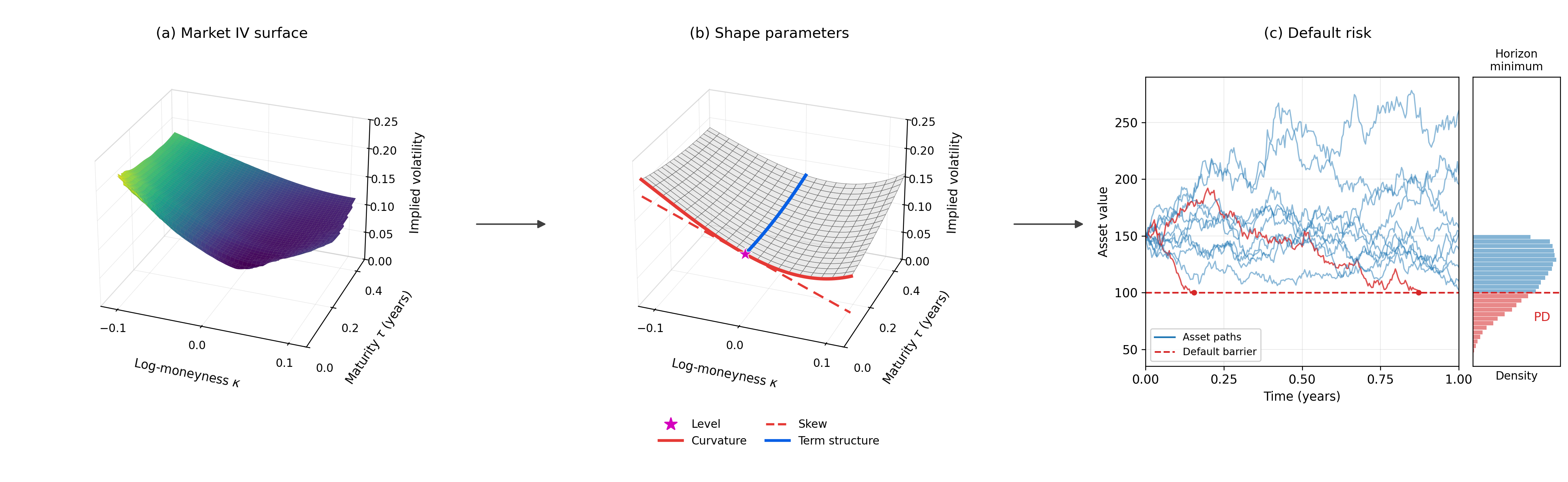
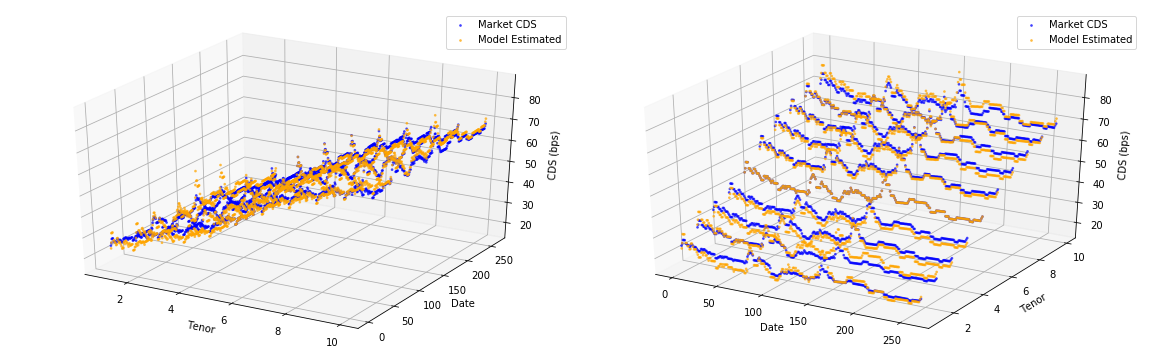
Research figure on estimating CDS spreads for illiquid counterparties

References

  • Su, W. (2023). Distance to Default Based on the CEV–KMV Model. Journal of Risk.

  • Arnsdorf, M., Horvath, B., Schismenos, S., and Su, W. (2026). A Semi-Parametric Equity-Credit Model for CDS Spread Estimation. Available at SSRN.

Path-Dependent Modeling in Financial Markets

  • Path dependence plays an important role in financial markets. For example, default may occur when a firm’s value first crosses a barrier, making its trajectory central to pricing and risk management.

  • Signatures provide a systematic framework for modeling path dependence. Our research establishes foundational statistical and no-arbitrage results for signature-based models.

  • Building on these foundations, we develop flexible models of asset dynamics that incorporate path signatures and accommodate established rough volatility models.

Research figure on path-dependent modelling with signatures

References

  • Horvath, B., Su, W., Su, W., Wang, B. and Zhang, R. (2026). How Fast Do Signatures Learn? Statistical Theory and Applications for Path Regression. https://arxiv.org/abs/2607.17865.

  • Arnsdorf, M., Horvath, B., Schismenos, S., and Su, W. (2026). Signature-Based Structural Models and Applications in Credit Markets. Available at SSRN.

  • Yang, T., Su, W. and Horvath, B. (2026). A Rough Instantaneous Squared VIX Model for Term Structure and Option Pricing. Preprint.